
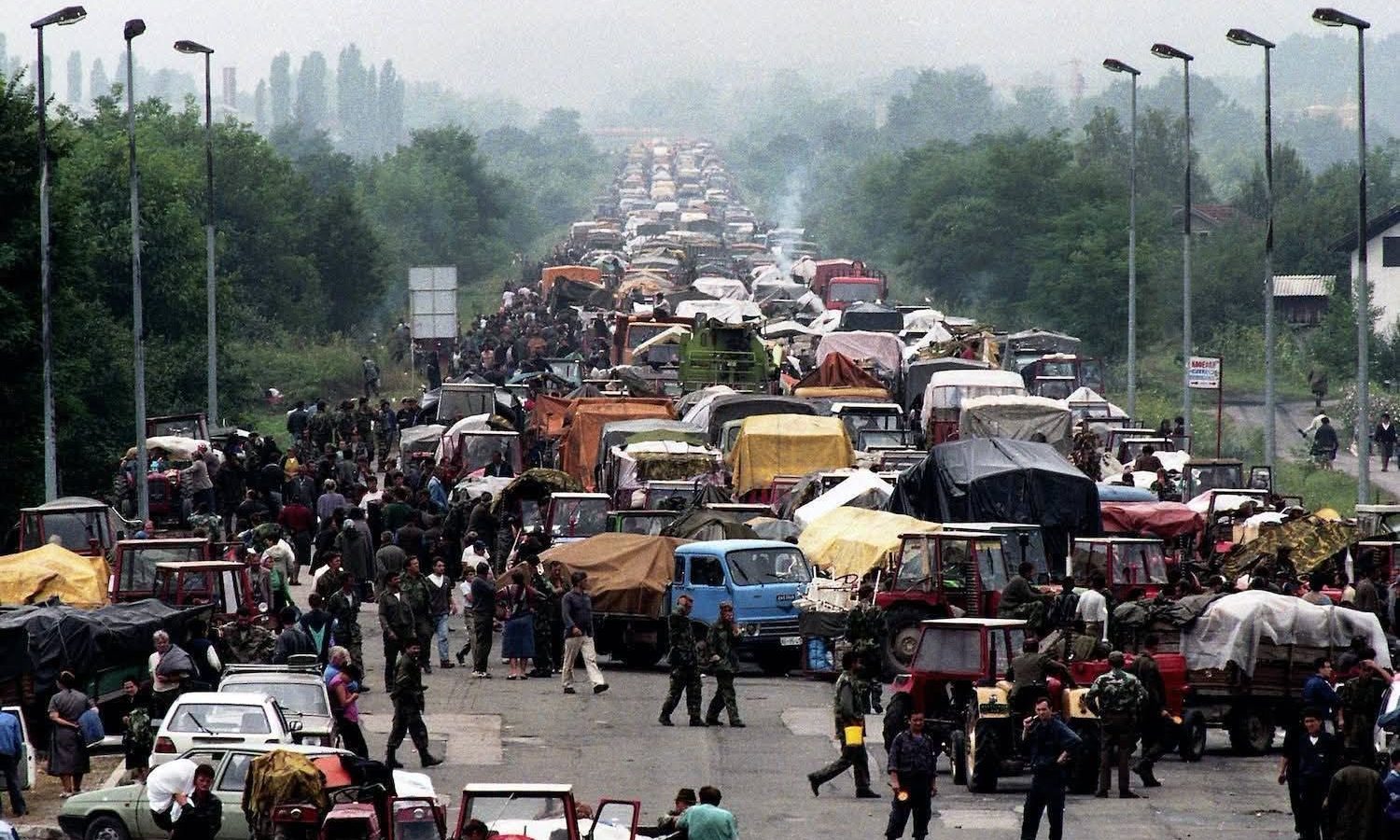
August 1995 - 200,000-250,000 Serbs flee from the Krajina within 72 hours. Tractors, buses, cars, on foot. Columns over 100 km long. UN observers safe. Ethnic cleansing in real time under the eyes of the international community.
The refugee column from the Krajina in August 1995 was the largest refugee wave in Europe after the Second World War - 200,000+ people expelled in 72 hours.
The beginning of the exodus - 4-5 August
The decision to flee
Why did they flee?
- Artillery fire on the towns (Knin, Benkovac, Obrovac...)
- Fear of a massacre - memory of Jasenovac (NDH 1941-1945)
- The RSK authorities - called for an evacuation (or ordered it?)
- The SVK (army) - withdrawing, unable to defend
- No guarantees - the Croatian Army did not guarantee safety
- Partly spontaneous - panic due to the shelling
- Partly organised - the RSK authorities ordered the evacuation of military families
- The result: A massive, chaotic flight
The first columns - 4 August afternoon
Knin:
- Already in the afternoon of 4 August, columns began to leave the city
- Tractors, trailers, buses, cars
- People packed what they could - beds, wardrobes, livestock
The main escape routes
Direction: Bosnia (Banja Luka)
The main road:
- Knin → Srb → Bihać → Banja Luka
- Distance: ~250 km
- Travel time: 2-5 days (depending on transport)
- Benkovac → Bosnia
- Obrovac → Bosnia
- Gračac → Bosnia
The columns - dimensions
Estimate by UN observers:
- Length of the column: 50-100 km
- Number of vehicles: 20,000-30,000 (tractors, cars, buses, trucks)
- Number of people: 200,000-250,000
- Speed of movement: 5-10 km/h (congestion, bad roads)
- Tractors with trailers - most common (farmers)
- Cars - overcrowded (8-10 people in a car)
- Buses - some organised, some private
- Trucks - with families and belongings
- On foot - those who had no transport
- Livestock - cows, sheep, goats (driven along beside the tractors)
Conditions on the road - a humanitarian catastrophe
Lack of basic necessities
Water:
- Enormous crowds - thousands of people waiting at a tap
- Many drank unclean water - fell ill
- Many brought food for a day or two
- After that - hunger
- No shops - everything closed or looted
- Non-existent
- People in the forests, along the road
- A hygiene catastrophe
- Minimal
- The old, the sick - died on the road
- Babies born on the tractors, on the road
Death on the road
Estimate:
- 50-100 people died during the flight
- Mostly old people (heart attacks, exhaustion)
- Some minors (dehydration, illness)
The UN present - but passive
UNPROFOR observers
UN mandate:
- Protection of the civilian population in the "UN Protected Areas"
- 15,000 soldiers
- They WATCHED the columns
- They recorded the events
- They provided some humanitarian aid (water, food - but minimal)
- They DID NOT STOP the attack
- They DID NOT PROTECT the civilians
- The mandate did not permit offensive action
- Political will - the West supported Croatia
- Fears of a conflict
Human Rights Watch: "The UN had a mandate to protect the civilians. Instead, they watched the largest ethnic cleansing in Europe after WWII and did nothing. This is a systemic failure."
Arrival in Bosnia - Banja Luka
Reception in Banja Luka
August 1995:
- 200,000+ refugees arrived in the Republika Srpska (Bosnia)
- Banja Luka - the capital of the RS - received the majority
- Capacity: Banja Luka could not receive 200,000 people
- Accommodation: Schools, sports halls, temporary camps
- Food: Insecure
- Healthcare: Overwhelmed
- UNHCR (the UN for refugees)
- The Red Cross
- International NGOs
- Provided aid - but insufficient
Further displacement
Some remained in Bosnia:
- ~50,000 remained in the Republika Srpska permanently
- Serbia: ~120,000 refugees from the Krajina
- Third countries: ~30,000 (Australia, Canada, the US, Germany)
Psychological impact - trauma
PTSD (Post-Traumatic Stress Disorder)
Studies:
- 50-60% of the refugees from the Krajina have symptoms of PTSD
- Depression, anxiety, nightmares
- Especially old people - died of a "broken heart"
- "Who am I now? I am no longer from the Krajina, but I am not quite a Serb from Serbia either."
- A sense of not belonging
- The children of the refugees - a "lost generation"
Testimony - Stana Knežević (58 years old, from Benkovac):
"For 30 years I have been living in Belgrade. But I am not from here. Every time someone asks 'where are you from?', I say 'from Benkovac'. But Benkovac is no longer mine. We are not there. My house was burned down. My children grew up here, they do not know Benkovac. I am a refugee. And I will be a refugee until I die."
Statistics of the exodus
Total expelled/fled:
- 200,000-250,000 Serbs from the Krajina
- That is ~80% of the Serb population of the Krajina
- 4-7 August (72 hours): ~150,000 fled
- August-September: another 50,000-100,000 expelled/fled
- Srebrenica 1995: 40,000 refugees
- Kosovo 1999: 500,000 Albanians (but over a longer period)
- Storm 1995: 200,000+ in 72 hours - THE LARGEST WAVE
"The refugee column from the Krajina was ethnic cleansing in real time. The whole world watched - satellite images, UN reports, TV cameras. And no one stopped it. This is a disgrace to the international community." - Amnesty International, 2005.
Sources
UNHCR - Statistics on refugees from Krajina
Human Rights Watch - 'Croatia: Impunity for Abuses' (1996)
Amnesty International - Reports on Operation Storm
OSCE - Observations of refugee columns
Svedočanstva izbeglica - Arhiva
Satellite imagery - NATO declassified
Location
Banja Luka (destinacija izbeglica)

Comments (0)
Be the first to leave a comment.