
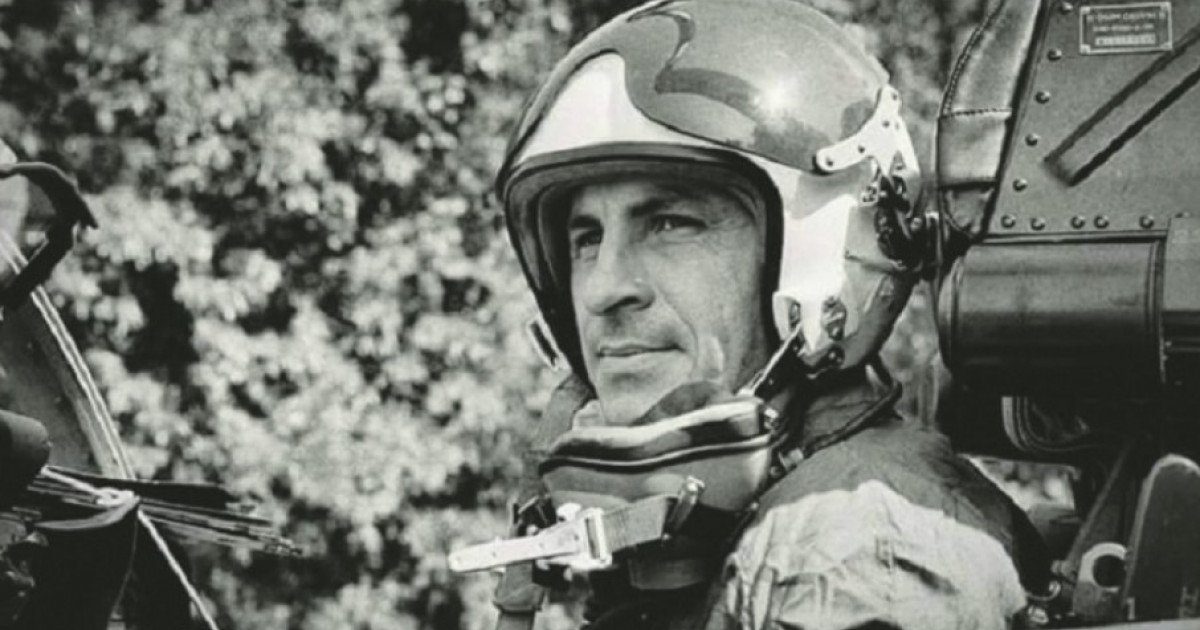
Colonel Milenko Pavlović, commander of the 204th Fighter Aviation Brigade, was killed on 4 May 1999 when his MiG-29 was shot down over Valjevo. He was the most experienced pilot, who flew into combat knowing he could not return.
Colonel Milenko Pavlović was the commander of the 204th Fighter Aviation Brigade of the Yugoslav Army, stationed at Batajnica airbase near Belgrade. On 4 May 1999, the 42nd day of the NATO aggression, he took off on his final mission, from which he did not return.
The life path of a pilot
Milenko Pavlović was born in 1960 in Serbia. From his earliest childhood he dreamed of flying. He graduated from the Air Force Military Academy in Mostar and devoted his entire career to fighter aviation. Before the start of the NATO bombing, he had over 2,000 flight hours, of which more than 1,500 were on MiG-21 and MiG-29 combat aircraft.
As commander of the 204th Brigade, he was responsible for the most valuable unit of the Serbian air force. His brigade was the only one equipped with modern MiG-29 fighters, which formed the backbone of Yugoslavia's air defence.
MiG-29 against NATO — an unequal fight
When the NATO aggression began on 24 March 1999, Serbian pilots faced an insurmountable adversary. The NATO coalition had over 1,000 of the most modern combat aircraft — F-15, F-16, F-18, Rafale, Eurofighter, Tornado — supported by AWACS early-warning aircraft, electronic warfare and satellite guidance.
By contrast, the Yugoslav Army had only 16 MiG-29 aircraft, of which just 11 were operational. These aircraft, though capable fighters, were technologically obsolete compared to NATO equipment. Their radars had a limited range, they had no capability to launch missiles beyond visual range, and their electronic equipment was a generation behind that of the enemy.
Despite this, Colonel Pavlović and his pilots took off into combat. Every takeoff was an act of extraordinary courage — they knew that the enemy could see them long before they could spot him.
The final flight — 4 May 1999
On that day in May, NATO aviation intensified its attacks on military targets across Serbia. Colonel Pavlović received notice of approaching enemy aircraft and decided to fly the interception personally. As commander, he could have sent one of the younger pilots, but he chose to sit in the cockpit of the MiG-29 himself.
He took off from Batajnica airbase and was vectored towards a group of enemy aircraft over central Serbia. Shortly after takeoff, his aircraft was detected by NATO electronic reconnaissance systems. He was intercepted by two American F-16 fighters from the 31st Fighter Wing.
In an unequal fight over Valjevo, Colonel Pavlović's MiG-29 was struck by an AIM-120 AMRAAM air-to-air missile. The aircraft exploded in the air. Colonel Milenko Pavlović was killed instantly, at the age of 39.
Heroism without a chance of victory
What makes Colonel Pavlović's feat especially heroic is the fact that, as an experienced pilot and commander, he understood the situation perfectly. He knew the chances of success were minimal. He knew that NATO radar systems tracked him from the moment he started his engine. He knew that the enemy had a technological superiority that could not be offset by courage.
And yet he took off. He took off because he was a soldier and because he believed it was an officer's duty to defend his country, even when the odds were hopeless. His example inspired all the pilots of the 204th Brigade to continue the fight until the last day of the war.
A memory that lives on
Colonel Milenko Pavlović was posthumously awarded the Order of Merit in the Field of Defence and Security. One of the streets in Batajnica bears his name. Every year, on the day of his death, the pilots of the Serbian Army pay tribute to their commander.
His sacrifice symbolizes the fate of the entire Serbian air force in the war of 1999 — small forces that stood up to an immense power, not because they believed they could win, but because they believed they had to try. In the history of aerial warfare, there are few examples of such a disparity of forces and such courage.
Colonel Pavlović is not just a number in the statistics of the war. He was a father, a son, a commander and a hero who knowingly laid down his life to defend the skies above his country. Lest it be forgotten.
Sources
Ministarstvo odbrane Republike Srbije — Heroji otadžbinskog rata
B92 arhiva — Gubici srpskog vazduhoplovstva
Jane's Defence Weekly — Yugoslav Air Force losses 1999
Location
Aerodrom Batajnica

Comments (0)
Be the first to leave a comment.